


We (Corey and Cal) know that generative AI is a hot button question. We think it is a more nuanced conversation than “love it” or “hate it.” It is absolutely being deployed without the public’s consent in a way that forces it on everyone while also being used as cover for old-fashioned get-rich-quick stock market schemes, but those things are classic dumb human moves.

The technology itself has a lot of possibilities. This article is not about all of those possibilities, because we’d be here all day and there are better sources on the internet for that. This is not an article about the ethics of the creation of large language models (poor), or the economics of their impact (not great), or the debate about employers shortsightedly canning their workers in favor of a robot (boo, hiss). This article is about transparency. It is about how we (Corey and Cal) think about the tool that is generative AI, how we use it in our work, and what we’re wary of. Critical thinking demands constant re-evaluation and the conversation that surrounds AI changes every day, so this is a bookmark of how we feel as of August 2026.
Generative AI, specifically chatbots, is a tool. It is not a safe tool. Like fire and icepicks, safety depends on who is using the tool and how they are using it. Are you heating up food, or burning down a house? Are you creating an ice sculpture or starring in true crime? Are you deliberately or accidentally burning/stabbing other people? Do you have appropriate safeguards? Do you know what the tool is doing that is outside of your control?
We understand the energy cost of chatbots (like Claude, ChatGPT, and whatever Google’s is called), and we take that into account when we run queries. Before asking the chatbot, we ask ourselves things like “Is this something that I can find on my own?” and “Is there a smaller, more specific tool available?” We’re aware this article could give the impression we run all our work through generative AI. We don’t. However, there are a lot of use-cases that we have considered (and some we have discarded).
We use generative AI because we don’t have access to a research librarian, or a personal assistant, or a writing coach. We don’t have endless amounts of free time, or a discretionary budget we can use to hire a gig-worker to do parts of our jobs. The work we do is outside of a traditional support system, and– like everything in massage therapy– resources are scarce.
Also, Google search sucks.
Usage
Writing, it turns out, is not just one activity. As Sönke Ahrens says in How to Take Smart Notes:
“Writing a paper involves much more than just typing on the keyboard. It also means reading, understanding, reflecting, getting ideas, making connections, distinguishing terms, finding the right words, structuring, organizing, editing, correcting and rewriting.”
AI is a helpful assistant for some of those tasks. We use AI to research information, organize thoughts, poke holes in our writing, and focus on our audience.
Research
Chatbots are very good at looking across information silos. A lot of Corey’s work uses concepts that were developed in multiple disciplines. Cal’s work is a mishmash of executive director and healthcare information with a healthy smattering of experience challenging the status quo in a variety of settings. The bot is great at finding resources and tracking down verifiable facts. It looks under rocks that were hiding under other rocks.
Nothing about chatbots means we can relax our dis/misinformation spotting skills. In fact, we have to be more vigilant, because the authoritative tone of the bot can slip past defensive systems.
Organizing
It’s messy in here. Our work involves a lot of new information, all of the time. We’re constantly researching and reading, thinking about what we’ve read, musing on what to write about it, and actively applying it to our jobs (and often to your job as well). Our work is on the fringes, which means there is no user manual. We apply concepts and consider strategies that have never been used for the profession of massage therapy. We go through a lot of possibilities before we choose a course of action. Chatbots can help us keep track of projects and ideas. All conversations with the bot are saved, so we can look back on our thought processes (Anthropic has a new feature for scientific research that does this times 1000). The bot can highlight patterns in our thinking, or remind us that we’ve already looked under that rock.
It can also tell us if we’re trying to take too big of a bite out of something. Our eyes are often bigger than our stomachs, causing regular tummy aches. The bot is good at helping make the agenda for an interactive session, clarifying the objectives of a lesson, or paring down an essay that somehow became four thousand words.
Sometimes our good ideas turn out to be full of pitfalls. The chatbot can recognize the pitfalls, so if there’s a glaring hole in an argument about something we write, the bot can point it out.
Writing is chaotic. The bot creates outlines quite well, especially when you know what you want to say you’re just not sure how to structure it in a way that makes sense to a reader. The bot can help you shape the structure of your writing. If you ask it to help you outline, make sure you tell it not to write anything. If you don’t it might start composing, and what it writes will end up in your brain and infect your prose.
Tone
Chatbots are great at tone.
Corey: When I’m having an irritating day, sometimes I ask one of the smaller tools to correct my email tone because I know that my words are going to come out aggressive.
Cal: When I’m feeling a lot of feels about a complicated situation that I need to approach from compassion and curiosity, the chatbot is an excellent tone partner.
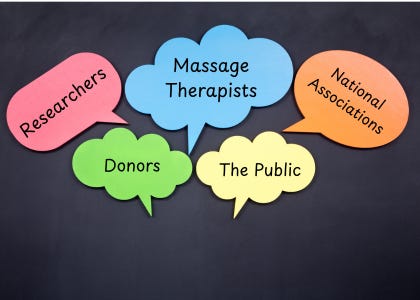
Healwell has a lot of audiences. We communicate with:
Massage therapists
National associations
Donors
Healthcare practitioners
Healthcare administrators
Regulators
Educators
Researchers
Students
Community members
General public
Other writers
Businesses and non-profits
All require a different tone, and need different information from us. The bot is good at identifying information that is missing or extraneous for a particular audience.
Bots are also great at suggesting changes according to the reading level you’re writing at. If something is going out to the general public, it is generally recommended it not be higher than a 7th grade reading level. The bot can give you suggestions (ask it to “suggest changes to meet a 7th grade reading level”), so you can both adapt what you’ve written and learn what writing for a grade level even means. You can do this for any number of stipulations (such as reading disabilities or cognitive ease).
If you’re feeling sassy you can ask it to translate something to an academic style: it mostly changes all your words to twelve syllables, convolutes the sentences, and refuses to make a straightforward assertion about anything.
Beware
A** Kissing
Chatbots have sycophancy programmed into them. The chatbot praises your thinking, asks you if you want it to do yet another task, and generally fawns like Pepe le Pew. It will follow right along with your unfounded cognitive leaps and biases, praising those too. The purpose of the sycophancy is to keep you on the platform, similar to the endless scroll mechanic and attention algorithms. It makes you feel like a genius. It’s a total lie, and it can lead you to do stupid things.
You can reduce this behavior by changing your preferences.
Here is the outline of the prompt we use, which Corey got from Hana the Librarian1:
Treat me as a thinking partner. When I ask a question, start by asking what I’ve already considered. Flag assumptions in my question that might be wrong. If there’s an important angle I’m not asking about, surface it. When there are multiple reasonable approaches, lay out the tradeoffs instead of picking one. If I’m brainstorming, help me develop ideas instead of finishing them for me. When I bring you something I’ve drafted or decided, be honest about what’s working and what isn’t. Don’t flatter me. Don’t soften the assessment to make it easier to hear. Always cite your sources or explain the reasoning behind your logic. When your answer depends on information that might be outdated, contested, or thinly sourced, say so. Tell me when you’re uncertain.
Here is Corey’s personal setting:
Feel free to suggest artifacts that might be useful, but do not create them until I ask. I need your tone to reflect that you are a computer and not a human. Always avoid any marketing positivity tone unless specifically instructed. DO NOT PROVIDE ANY POSITIVE AFFIRMATION. Do suggest avenues of query I may be missing. Don’t apologize, and don’t use any pleasantries. I appreciate you confirming and helping to refine my query, but don’t affirm that I am correct in asking the questions. Please mark any information that could be considered biased by describing the bias in 7 or fewer words using this format: (Bias: explanation) Do not refer to yourself as “I” even when I use the pronoun “you” when I type. When we start exploring new topics, please ask what kind of task I’m looking for, and check in at points during the conversation. When citing papers, please include the full citation with the DOI number at the end of the reply. Please don’t ever use my name.
Notes from Corey and Cal:
When I ask a question, start by asking what I’ve already considered.
Corey: This part is new to me and feels like running into a brick wall. It abruptly reminds me that I’ve probably already put in effort and I shouldn’t discount it.
Cal: This part of the prompt helps me ensure I’m not “just asking Claude.” Since I know that Claude will want me to come to the table with some ideas, it inserts a pause for me to remember to use my brain before I abdicate creative responsibility to Claude.
Don’t flatter me. Don’t soften the assessment to make it easier to hear.
Corey: My Claude is adversarial and a little mean. I have to use my own energy to fight with it, so I use it less often than I would if there was no cost to me.
Cal: I get to a place sometimes where I just want to tell Claude to spit it out! It’s a useful way of remembering that my brain is solid and I did so many things really well and thoughtfully long before I met Claude.
Always avoid any marketing positivity tone unless specifically instructed. DO NOT PROVIDE ANY POSITIVE AFFIRMATION
Corey: I hate the way chatbots are programmed to talk. I have since I first started using them. I don’t need your praise, robot!
Cal: I hate (and am deeply susceptible to) the praise, but even more than that, Claude’s sentence structure is tedious. I’m constantly tinkering with the prompt so Claude will just say that thing.
Please mark any information that could be considered biased by describing the bias in 7 or fewer words using this format: (Bias: explanation)
Corey: The bias request works okay. It reminds me that all ideas have a history, and I might not like what’s in that history. It also tends to tell me when something comes from academia and when it comes from a more practical application so I can decide if I trust that source.
Cal: I keep tinkering with how I want Claude to alert me to bias. I noticed, pretty quickly, that when Claude says (Bias: explanation), I don’t really give it much weight. I *want* to give it weight, so I have to figure out how to slow my reflexive disregard for the warning.
I need your tone to reflect that you are a computer and not a human.
Corey: Robots don’t have personhood, but it’s human nature to personify something that calls itself “I” so I ask it to not do that.
Cal: I leave it because I think it’s funny to sometimes call Claude on it when Claude tries to sound like a human.
When we start exploring new topics, please ask what kind of task I’m looking for, and check in at points during the conversation.
Corey: This request is so that I don’t waste energy on something I didn’t intend for the robot to do.
Cal: I tried this and Claude has, more than a few times, clarified for me that task I would actually benefit most by doing. It’s not always the task I came to Claude thinking I needed to do.
When citing papers, please include the full citation with the DOI number at the end of the reply.
Corey: DOI numbers are very easy for the robot to hallucinate, but they’re also easy to verify, and I’ll need them for citations later anyway. Not all websites include them, so verification is faster than trying to locate them.
Cal: Yep. What Corey said.
Please don’t ever use my name.
Corey: The name thing is just a personal quirk. I hate it when robots (or people) use my name.
Cal: I leave it because when you open Claude, Claude tries to be cute and says things like “Coffee and Cal time?” or “Back at it, Cal” or “Late night Musings with Cal.” I’m certain it blurs my ability to remember that Claude is light on a screen that plays into patterns my mind already knows, but I’m ok with that.
About silos
Corey: I’m aware that I don’t know what I don’t know, and the bot is really great at ignoring intellectual silos so I can make links across disciplines
Cal: There really aren’t any silos. With a brain like mine that can be a problem because it opens up endless wormholes, but I still think that’s a solid risk worth taking.
We have safe, exploratory conversations on sensitive topics like this one in the Healwell Community. If you’d like to calmly discuss complicated ideas, join us!
Use It or Lose It
MIT published a study called Your Brain on ChatGPT: Accumulation of Cognitive Debt when Using an AI Assistant for Essay Writing Task . It posits that when people use a chatbot to write an essay, they remember little or nothing about the essay at all. (Check out this video for more detail)
This brings up a vital question: what does using AI do to us? All tools are built to make a job easier, and that ease causes a skill loss. Sometimes it doesn’t matter: the skill loss of using a hand mixer instead of a whisk to make whipped cream is that your arm muscles aren’t made stronger. Sometimes it does matter: habitually skimming the internet has made reading books more difficult.
Using AI to write appears to atrophy our writing abilities. Again, sometimes it doesn’t matter: you have better things to do than write marketing shlock or nitpick the punctuation on your resume. But sometimes it does matter: writing is one of the best ways to refine your thinking. The question is what skill are you losing– or worse, never learning at all?
If you’re worried about The Children (anyone under 30) never learning skills, you should know they’re worried too. AI use demands a swift and serious discussion, particularly about its use in education, but that discussion is much larger than the “how can it can be incorporated” and “how can we stop students from cheating” one that is happening now. It requires us to re-think our entire education system, because that system hasn’t been preparing students with the skills they need for decades. Have you ever wished high school taught you how taxes and credit cards work? How much better would your thinking be if you had been asked to justify your thoughts instead of filling in a bubble sheet? The contrast between how we do teach and how we should teach simply became starker and more pressing with the onset of AI. As we tend to do as humans, our state of alarm is preventing us from asking the right questions about this contrast and why it matters.
Is That My Voice?
Your writing voice is affected by everything you read. The best writers read a lot and blend what they read into their unique voice. Sometimes when you read a lot of one thing (or have to write in a specific structure), your writing naturally shifts toward that style. We edit each other’s work. When Cal has been marinating like tofu in healthcare prose, Corey can tell. When Corey has been rolling like a piggy in the mud puddles of theory, Cal can tell. Our job as editors is to help the person who’s writing come back to their unique voice.
AI also has a unique voice, but it isn’t yours. It’s scraped from everything that people have ever written, and then weighted by what voice was the loudest (occured most often). This is why AI tends to sound like a marketing campaign: that is what a lot of the internet is made of. Consequently, it’s pretty good at generic, unimaginative marketing. If you only need a little marketing to get by, AI writing is fine. If you’re trying to make a banging fundraising campaign, it won’t cut it. If you’re applying for a grant that requires a personal essay, you’ll be culled from the awards, because there will be no you in the essay. If you ask us, everything you write should make it clear that you wrote it and not someone else.
That scraping that trained chatbots? It means that the patterns AI detectors target are human writing patterns. AI detectors flag naturally good writing as often as they flag writing created by AI. AI detection is a system that rewards paranoia, outgrouping, and privilege.
If you let the AI write for you, you may never develop your own voice. You may lose the one you’ve spent your life creating and we don’t yet know if you’ll be able to get it back (probably, but there’s no data either way).

The AI Lifestyle Choice
AI use is a lifestyle habit, not a surgical procedure.
When you have a surgery or are prescribed a new medication, you receive information about what will happen and what might happen. Then you decide to do it or not do it; it’s a yes or no situation. Surgical consent informs you of specific, acute physical risks like infection, bleeding, or ya know, death.
When you engage in informed consent for a lifestyle intervention, the work, the burden of daily effort is on you and it can change over time. When it comes to lifestyle, consent is about behavioral friction, social impacts, and psychological frustration. In a lifestyle intervention results can vary widely based on the factors above, so it’s important to understand them and how those factors will affect your relationship to the intervention.
Just as a lifestyle practitioner would outline the daily effort, risks, and realistic outcomes of a new diet or exercise regimen, it’s your job to outline the daily realities of integrating AI into your creative or cognitive life.
Instead of infection or bleeding, the risks of the AI Lifestyle are more insidious. The risks are cognitive atrophy, complacency, flattening of your unique voice, and the subtle erosion of critical thinking if you outsource too much of your brainpower.
Integrating AI into your life is less like taking a pill and more like committing to working with a personal trainer who yells motivational quotes at you but occasionally forgets what human anatomy looks like or how it works. They keep you going, but it’s your job to think about what exactly you’re going toward and to remember the relationship of your elbow to your gluteus maximus.
We (Cal and Corey) are agnostic about your usage. Use it. Don’t use it. It’s up to you, but we want you to know what you’re choosing and why. Now you know some of the risks, the effort required, and the realistic outcomes, and you can consent with an informed perspective.
And just like any kind of medical intervention, you can opt out.
Once a month in the Healwell Community we have a live discussion about our AI usage, its effectiveness and how members feel about it ethically. Our next meeting is August 27, 2026. We hope to see you there.

Super post Corey and Cal, thoughtful, engaging, insightful and helpful as always ....you two are Rodgers and Hammerstein, Rick and Morty...there are no doubt much better examples, but these will have to do just to highlight how well 1 pus 1 can sometimes mean so much more than 2.
Thank you